Homo whataboutus, Homo belligerensis: A field guide to some new species in times of war
A naturalist writes of her experience observing these creatures in their natural habitats.
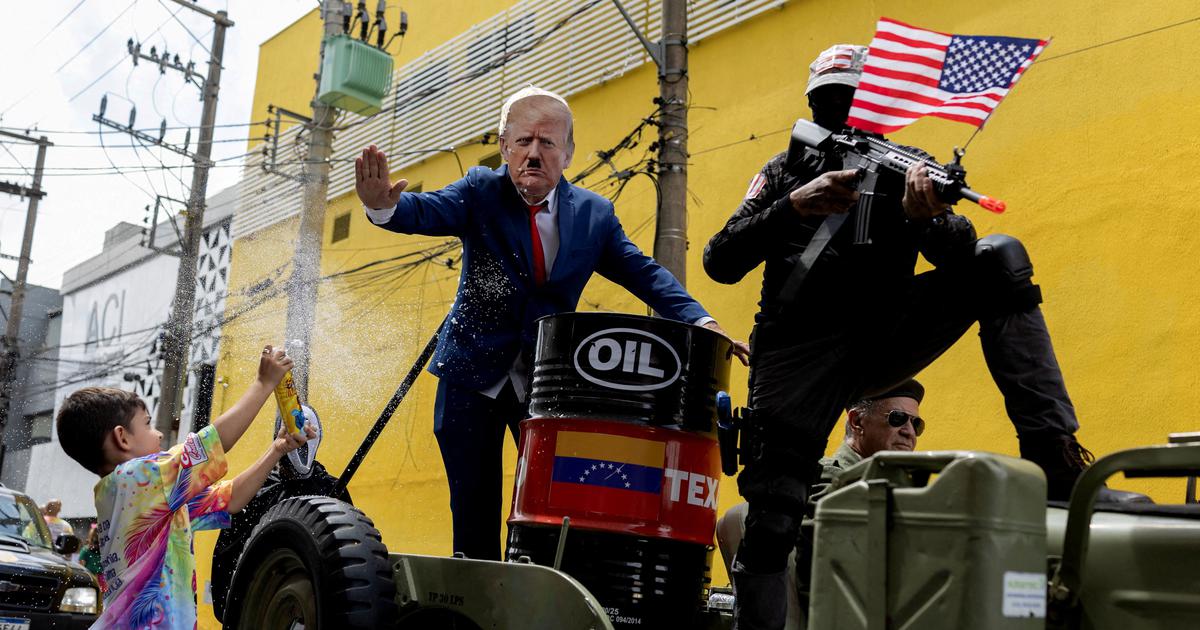
May 01, 2026 · 09:00 am A reveller wears a mask depicting US President Donald Trump during a street Carnival parade in Sao Jose dos Campos, Brazil, in February. | Reuters
Walking through a mesh of memories of death and destruction requires endurance – as I found out while visiting the War Remnants Museum in Ho Chi Minh City in March.
The photographs recapping the Vietnam war do not let you look away. And the museum does not bother with euphemisms. It simply shows you what happens when nations decide that bombs are a form of diplomacy.
There is the iconic photograph of a girl running naked down a road, her skin burning from napalm. Villages turned into charcoal sketches of themselves. American soldiers posing with severed human heads like trophies. Farmers lying where their rice fields once promised harvests.
Then there are the victims of Agent Orange, the experimental chemical warfare that stripped millennia-old forests and left behind children born with deformities – even foetuses with six eyes and three mouths.
If Vietnam was not sobering enough, a few days later I went to Cambodia to the Tuol Sleng Genocide Museum: a former school that the Khmer Rouge converted into a torture centre. Under the dictatorship of Pol Pot, nearly two million Cambodians were systematically murdered in a campaign that combined ideological purity with chilling logistical efficiency.
Two days later, while still in Cambodia, came the news of the US-Israel war on Iran. It all sounded familiar: an unhinged administration, warmongering dressed up as a fight for justice, dubious explanations to legitimise a war, and yet another obituary for humanity.
Walking through those museums, and then hearing the news of the new war breaking in West Asia, the naturalist in me began to recognise the various editions of the 21st-century Homo sapiens, a set of sub-species, if you will.
Homo belligerensis, the Permanent Warmonger
Members of this species are convinced that the solution to most problems is simply one more war. This species speaks of conflict with the calm assurance of someone ordering a double cheese burger. They themselves are rarely near the battlefield.
History, one would imagine, should function like a vaccination: a small exposure to past horrors so that societies develop immunity against repeating them.
Instead, humanity treats history like a Netflix series: something to binge-watch while comfortably assuming we will never be part of the plot.
Humans, it appears, have the memory span of a goldfish when it comes to war.
Homo petro-principalis, the Oil-Friendly Idealist
Closely related to Homo belligerensis, this sub-species is passionately committed to human rights, democracy and the rule of law except – when those principles threaten the uninterrupted flow of oil, gas or strategic minerals.
When such inconvenient conflicts arise, the species displays an extraordinary evolutionary adaptation: moral flexibility. Sanctions, outrage and speeches about justice can all be postponed until the pipelines are secure. Human rights, of course, must flow – preferably in barrels.
To paraphrase one, “Oh yes, Genesis 15:18 speaks of the promised land from Nile to Euphrates. Netanyahu is just the facilitator. Can you believe Iran is blocking the Strait of
Homo selectivus moralensis, the Selective Moraliser
This species possesses a powerful moral compass but it works only in certain directions. It can detect injustice thousands of miles away, provided the perpetrators belong to the approved category of villains.
When the wrong people commit the wrong acts, however, the compass begins spinning mysteriously.
“What Pol Pot did was monstrous,” they’ll say, before adding, “But this is different. This is about making the world safer… from them.”
Homo whataboutus, the Whatabouter
When confronted with wrongdoing, this species immediately produces a list of other wrongdoings committed elsewhere, at other times. Within seconds, the original issue disappears under a pile of unrelated historical grievances stretching back several centuries. Homo whataboutus believes this is the same as solving the problem.
Homo cynicus maximus, the Grand Cynic
Having watched the behaviour of the other sub-species, this creature concludes that morality itself is an elaborate performance and outrage merely another form of entertainment.
Homo cynicus maximus observes the chaos of the world with a weary shrug and a perfectly timed tweet: “Thoughts and prayers for the concept of humanity. It was a nice idea.”
Homo numbus, the Emotionally Numb
This sub-species reports news fatigue. With constant crises, the world feels overwhelming and surreal. It might care deeply but can no longer process.
Not all new species are quite so exhausting, however.
Homo compassionatus universalis, the Universal Empath
This is a rare but resilient sub-species. It condemns injustice regardless of who commits it or who suffers it. It is often accused by other sub-species of being naïve, idealistic or insufficiently patriotic.
Observing these creatures in their natural habitats, there is a sense of tragic predictability. Tourists take photographs in war museums and shed a tear or two. The generals retire. The politicians write memoirs. The arms manufacturers diversify. The children inherit the consequences.
While we are busy perfecting the art of killing one another, we also conduct a parallel campaign against the planet. Apparently, destroying nature at breakneck speed was not quite ambitious enough – we also felt the need to organise occasional wars for variety.
Outside the museums in Ho Chi Minh and Phnom Penh, is the cheerful chaos of Southeast Asia. Scooters buzz like caffeinated dragonflies, cafés spill laughter onto pavements and tourists – including me – wander about wondering whether to photograph their coffee before drinking it.
Life, stubborn and impressively indifferent to history’s worst habits, goes on.
The question that lingers is not simply whether we will repeat the past. We are repeating it. The more unsettling question is whether there will even be anyone left to build museums for the future.
Arefa Tehsin is an author and Ex-Honorary Wildlife Warden, Udaipur. Her most recent book is The Witch in the Peepul Tree. She writes at www.arefatehsin.com.


Leave a Reply