
In Good Faith | Let’s listen to the birds, the trees and the Aravallis
The Aravallis are old. Old enough to know better than to expect gratitude. Older than the Himalayas, older than our arguments. The low hills with no interest in grandeur. That, perhaps, is their biggest mistake.
Written by: Arefa Tehsin
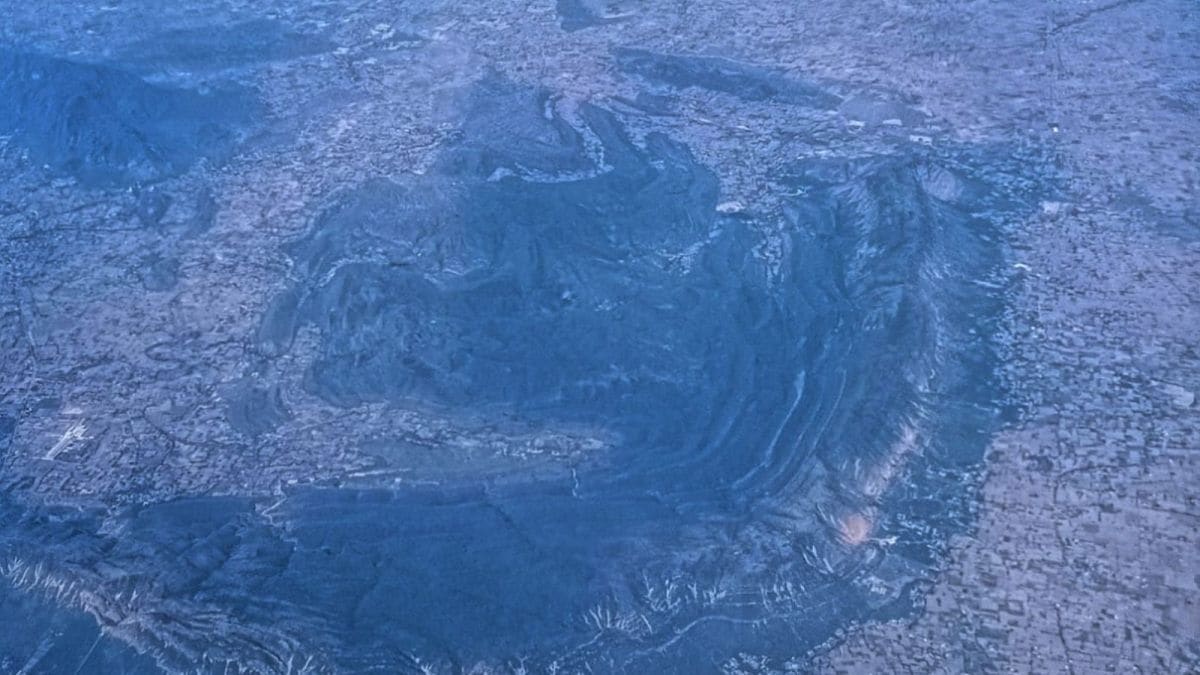
An aerial view of the Aravallis surrounded by dense human settlement in Haryana
As lonely as a tree, we say. But is a tree lonely? A tree – rooted, breathing, hosting entire worlds on its bark and beneath its feet – is offered as the ultimate metaphor for isolation. If a tree is not lonely, then are we? Or is loneliness a modern myth?
There are growing scientific speculative theories and philosophical exploration on shared consciousness (of all things and beings in the universe) as a fundamental field, similar to quantum fields. The concept is not new. It has existed in religions and indigenous cultures for centuries. The non-dualism of Advaita Vedanta speaks of shared consciousness in its purest form, and individuality as maya. Buddhism rejects a fixed soul and emphasises on interbeing and sunyata. Wahdat al-Wujud (Unity of Being) is one of the core ideas of sufism.
I distrust anything that sounds too cosmic, too New Age, too eager to comfort. Shared consciousness? Universal fields binding all beings? I would usually roll my eyes and ask for peer-reviewed journals.
But an idea doesn’t have to be cosmic to be dismissed. Sometimes, it just has to be quiet. The recent Supreme Court order, for instance, made me question my scepticism. It seemed to suggest that low hills…low…are dispensable.
Aravallis around Udaipur have been an extension of who I am, who my family is. I grew up in their lap. They are an extension of my nervous system, my consciousness. My younger years were folded into their valleys: the weekly family outing to their streams, the summers spent in their forests, the best friends the kids of the forest-dwelling tribes. These hills raised me as much as any adult did.
As the hills declined with exploding population and development, so did something else: water levels, wildlife, weather predictability. My father fought for their preservation with ferocity for decades. My family’s sense of physical and emotional well-being rose and fell in quiet parallel with the hills.
The Aravallis are very old. Old enough to know better than to expect gratitude. Older than the Himalayas, older than our arguments. The low hills with no interest in grandeur. And that, perhaps, is their biggest mistake. Existence, in the new world order, must justify itself quarterly. The bigger the scale of a building or statue, the greater the declared pride. There is something global about this attitude. Donald Trump once reportedly asked why the US couldn’t just rake forests to prevent fires…at which point I felt confident my toothpick could hold its own in an ecological debate.
The low Aravallis quietly stand absorbing impact, ecological shock absorbers for a civilisation that has been riding without brakes. What makes the Aravallis especially tragic is that they were never asking for reverence. No temples on every peak. No pilgrimage circuits. Just the courtesy of being left alone.
We are told that development and ecology can coexist. They always can. On paper.
To understand why this is such a fragile lie, take one single tree, the one we insist on calling lonely.
A tree is not one life. It is a full-fledged republic. A Parliament session that never adjourns.
Look closely. On its trunk, creepers climb with breathless ambition. They have no intention of photosynthesising independently; why bother when someone else has done the hard work of standing upright for decades? They cling, twine, and slowly tighten their grip, whispering sweet nothings about ‘mutual support’. In time, the tree can barely breathe. This is called ‘strategic partnership’.
Then there are the parasites like fungi, insects, borers. They don’t even pretend affection. They burrow straight in. They hollow the tree from inside until one day it collapses during an unremarkable storm, and everyone says, “Arre, it looked so strong!”. Yes. On the outside. Like democracies. Like institutions. Like you and me.
A tree also shelters birds. Some sing. Some scream. Some drop things on your head with excellent aim. These are your opinion-makers. They fight loudly for branch-space, conduct dawn-to-dusk debates, and occasionally forget why they started shouting in the first place.
Lower down, ants march in disciplined lines, carrying crumbs ten times their size. Nobody interviews them. Nobody tweets about them. But without them, the tree would drown in rot. These are your workers. Your farmers. Your municipal sweepers. Your delivery executives cycling through heatwaves while the rest of us argue about nationalism from air-conditioned rooms.
A single tree has seen more regimes than Doordarshan reruns and has a longer memory than WhatsApp forwards.
So how many worlds exist in the Aravallis?
Thousands? Millions? Each hillock hosting overlapping republics: some noisy, some ancient, some newly arrived. Leopard corridors crossing human boundaries. Aquifers remembering rain from decades ago. Countless bushes, shrubs, rocks, streams, animals and ‘lonely’ trees sharing their consciousness.
Loneliness, for me, now feels a symptom of disconnection we actively manufacture. What if we feel increasingly isolated because we are actively severing links with land, with non-human life, with memory, with place? How can someone who shares her consciousness with flowers, bees, roots, stones, and seasons truly be alone?
The Aravallis were never lonely. Or low.
They are custodians. And like all custodians, they are noticed only when something breaks.
The tree was never lonely.
We were.
And in treating parts of our living world as dispensable, we are not asserting power.
We are announcing how profoundly alone we have chosen to be.
 Arefa Tehsin
Leave a comment