

Let there be light: This Diwali, let’s embrace the unfiltered glow of community and connection
Light has no religion. It simply shines wherever it’s given a little oil and a little heart
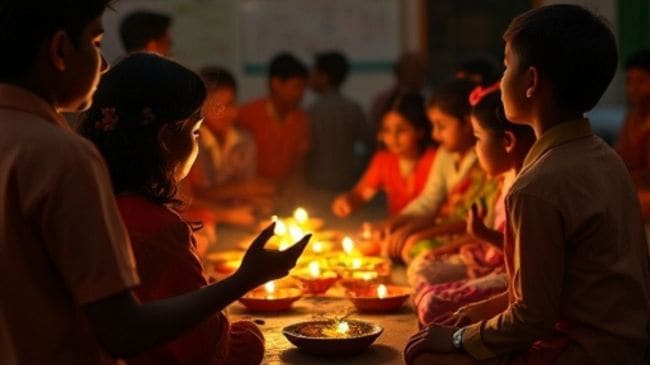
This Diwali, when we clean our homes and decorate our thresholds, let’s proudly reclaim the messiness of our mingled past, the imperfect but glowing faith that believed joy is more contagious than fear
Let me tell you: I love the dark. The peace that comes when the world stops competing to shine. “What would you like with your Parle-G, beta?” Lalima Aunty would ask me. “A night forest,” I’d say. But for that one night of Diwali, I’d trade a night forest for wicks that trembled like small acts of rebellion against absolute darkness, or perhaps, against absolute certainty.
Eid and Diwali have always been my two favourite festivals. But if push came to shove, I’d say Diwali. On Eid, we would dress up like dandies and go about pinching our Eidi from indulgent adults. Diwali, though, began a day earlier, when my Dadijaan would roll baatis and soak the diyas in water overnight. It has no ritualistic significance, this soaking of diyas, as every other Indian would know. It is our quietly pragmatic yet ungenerous act to stop the thirsty mud from drinking up the oil meant for the flame.
There’s something moving about a night that insists on remembering the sun. This makes me sound as old as the Aravallis, but I come from a time when there was no talk of ‘interfaith dialogue’. Just shared laddoos, mathari, burnt fingers and light that didn’t check the surnames. Our annual, pan-Indian conspiracy of glow.
The Bohras of Bohrawadi exchanged sweets with the Purohits of the next lane. The Jain uncle would welcome us at home, but only before sunset. In our family lane in Udaipur, my Dadijaan would not leave a single corner unlit on the Diwali amawasya though it required hundreds and hundreds of lamps, just as my aunt Habiba never forgot to make gujiyas on Holi. Both perhaps whispering a small bismillah before beginning their festive missions. They were the generation of the blissfully unaware, who practised pluralism by instinct, not instruction.
I smell something else in the air this Diwali. Not ghee, but guardedness. Not smoke, but suspicion. The lamps have multiplied but their glow feels more curated like ‘Happy Diwali from the Merry-go-round family’ or from ‘Diwali Wishes from The Twinkletoes’ in colour-coordinated outfits. Instagram posts that sparkle but don’t warm. The word “syncretic” now sounds like something you’d need antibiotics for. And joy is a gated community.
Maybe what we need, in this atmosphere more vicious than Delhi’s winter air, is not grand ideas of secularism or tolerance, but small, shared absurdities. The Hindu, Muslim, Christian, Sikh boys running away from their girl classmates on a Rakhi day. Punjabis and Bengalis arguing over who makes the best biryani (and we haven’t even taken Hyderabad into account!). Fernandes Aunty claiming to be a better gossip than Sharma Bhai Sahib. This is the India that has refused to grow up into neat categories. Our languages share proverbs, our Hindu gods grace Biblical calendars, our festivals share calories. Somewhere between Holi colours and Christmas confetti, the horizon shimmers with an unlabelled light of countless festivals.
Darkness, as Kabir might say, doesn’t come from the absence of gods but from the absence of empathy. And empathy was once our second nature, as effortless as wishing your neighbour on a festival you didn’t celebrate, yet somehow did.
This Diwali, when we clean our homes and decorate our thresholds, perhaps we should dust off the unseen cobwebs that have started to settle in the corners of our hearts. Let’s proudly reclaim the messiness of our mingled past, the imperfect but glowing faith that believed joy is more contagious than fear. Just laughter, laddoos and a collective sense of belonging that didn’t require Adhaar cards.
So, this Diwali, when we polish our silverware and line up our diyas, let’s light a lamp for Ram, a lamp for Rahim and perhaps one for reason. Because reason says, true darkness is not when the power goes out, it is when compassion does.
After all, light has no religion. It simply shines, wherever it’s given a little oil and a little heart.
Tehsin is the author most recently of, The Witch in the Peepul Tree, and The Great Indian Safari
 Arefa Tehsin
Leave a comment