


A journey through Egypt, ponderous with history, yet weightless like a dream
A cradle of civilisation, ancient Egypt was at the helm of military and cultural might. Everywhere you turn to, you can see the imprint of its glorious past
Written by Arefa Tehsin
Updated: July 20, 2023 16:56 IST
On the River to Afterlife
By Arefa Tehsin
We look at the sky and ponder over ‘possible worlds’. What about the impossible worlds that exist in our very own?
“Egypt is a funeral civilisation,” our guide pronounced as we stared at the long-dead toes of a girl. A doctor had created a special contraption for an aristocrat’s daughter to walk when she lost a part of her foot. The invention left us dumbstruck. Even as the Stone Age was ending, Egyptians had started building gold covered tombs and temples that would last millenniums. Heck! Even their dead feet lasted that long.
A civilisation that incredibly spanned 3000 years, the Pharaonic Egypt covered in the sands of the Sahara was on our bucket list, which had caught rust during Covid. When the world opened, we went romping around the intercontinental Misr—ponderous with history, yet weightless like a dream.
A cradle of civilisation, Ancient Egypt was wrought with military and cultural might, religion and spirituality, innovations like papyrus and the written language hieroglyphs, geometric precision to build pyramids and a central government. The day was measured in 24-hours, a year in 365 days and the amount of tax to be paid by farmers by the water in the ‘well of taxes’, which measured the level of the Nile. The more it flooded, the better the harvest. Now if that isn’t ingenious, wheel isn’t too.
On the first day, after our travel planner Atef Gomaa of Blue Heaven tipped us about giving tips (which can be requested, demanded and coerced, everywhere, for everything), we made a beeline to the Great Pyramid and Sphinx bathed in the stolen light of our nearest moon, and built with millions of tonnes of stones and promises of an afterlife.
It is indeed a funeral civilisation. The ancient Egyptians spent their lives preparing for death. They didn’t build palaces but tombs filled with every perceivable need. Imagine the beautiful Nefertiti admiring her lapiz lazulis and smiling at the vision she’d look in heaven.

Cruising on the Nile by Adityavikram More
Egyptians had gods for everything, from the god of mummification Annubis to sun god Ra. But the true goddess that gave birth to Egypt is Nile. Her fertile delta provided food and papyrus. Her waterways ferried goods (including mammoth obelisks and pyramid blocks) and armies. Her flooding transformed deserts into farmlands. Her cycles formed the Egyptians’ identity and philosophy of life, death and rebirth. They saw their creation in the river, like you see your mother’s face in your own.
Nile flows like a poet. We sailed on the world’s longest river chasing the past littered on its shores. You stop between Luxor and Aswan to see the monuments that dazzle and frazzle, cross the Esna Lock and feel as if you’re sailing on Pharaoh Khufu’s papyrus boat to heaven. We sadly didn’t chance upon Nile crocs or the Egyptian Vulture. The ‘pharaoh’s chicken’ seems to have vanished with the protection it once got under the Pharaonic law.
The temple of Sobek–the croc-headed god of Nile–with crocodile mummies at Kom Ombo, the temple of Horus to be reached in a carriage bumping on crater-sized potholes, the complex Complex of Karnak, the massive Aswan Dam my father remembered from the time of Colonel Nasser and the gorgeous island of Philae dedicated to Isis. Osiris, Isis’husband, was killed by Seth, who scattered his parts all over Egypt. Isis’ sorrow and sexual desire sent her collecting Osiris’ tit-bits. She found all except one—his phallus—and breathed life into him. Soon after, they copulated and Horus was born. Don’t ask me how. The land is full of bizarre tales and profound mythical wisdom. Some scholars point at similarities between Isis-Horus and Mary-Jesus.
Abu Simbel, on the border of Sudan, that celebrates Ramses II and Nefertiti, is a historical heavyweight. When the temple faced a possible submersion by the making of Aswan Dam, the world came together to save it believing it was not the history of Egypt but humankind.
Gawping at the mummy of Ramses II, I remembered Marilyn Monroe’s scribbling, “you must be-/ alive—when looking dead”. He had a great vision of a nation and himself, erected the greatest monuments, lived into 90s when the average lifespan was 35, sired more children than any and outlived most of them. He is the basis for Shelly’s poem Ozymandias. If you think you are already a relic in your middle age, let Ramses II step back and take a bow.
And yet, King Tut, an inconsequential king, caught the world’s imagination. President Hoover couldn’t resist naming his dog after him. The boy king with a curved spine was buried in the Valley of Kings. By the time Carter chanced upon the small but intact tomb, most of the greater tombs had been raided; even a few of the mummies stolen to be consumed as aphrodisiacs. Tutankhamen’s dizzyingly dazzling treasure now lies in Cairo Museum—a 120kg gold coffin, jewellery, weapons and not to forget the 145 linen underwear!
After the heady history lessons, we reanimated ourselves at Red Sea. Marsa Alam, with its remote outpost ambiance, is a kaleidoscopic underworld, a diver’s dream. It was cleaner than the rest of Egypt, which has pyramids of garbage people are astonishingly heedless of (not that we, in India, can correct that attitude without divine intervention!).
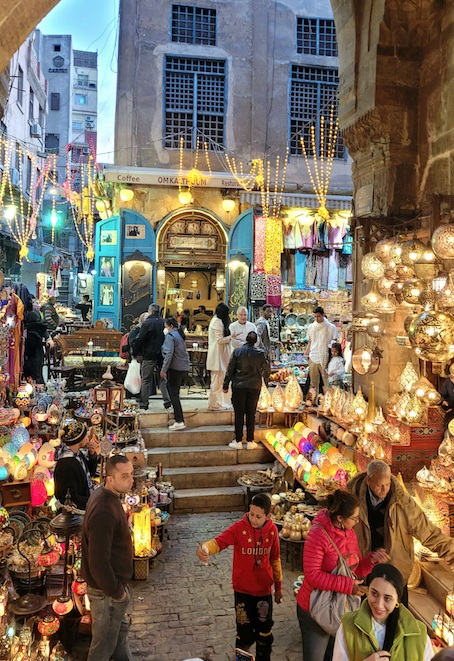
Al Qahira, the City Victorious, became Cairo to the twist of the European tongue. After the monastic Coptic Cairo and glamorous Islamic Cairo, we braved the tide of humanity at Khan-al-Khalili, the centuries old souk where touts stand cheek by jowl hawking their wares. Our wrists daubed with perfumes, we finished our sojourn to this grand epic with sheesha and stuffed pigeons.
“…the heart is an organ of fire.” Ondaatje had written. You do perceive a warmth in your chest as you remember the famous curse standing inside King Tut’s tomb or experience Hatshepsut’s undying mojo at her mortuary temple.
As we followed ensemble after ensemble of funeral goods, somone asked, “What would you like to be buried with?”
“Just one item,” I declared, rubbing my hands in the January cold. “A Kindle.”
For which would be a quieter place to read than the river to afterlife?
Arefa Tehsin, most recently of The Witch in the Peepul Tree
 Arefa Tehsin
Hey my dear Arefa, this is a nice practical composition about your trip with us in Egypt, the gab in the story myth of Isis and Osiris of how Horus was born from coupling Isis with her dead man Osiris is the secret of the mummification, after Isis collected the scattered Pices of her Husband body, she assembled it with the collaboration of the God Thot creating the first ever mummy the missing organ( Phallus” was replaced by a an artificial one fabricated from the slush of the Nile( That is explained the fertility of the Egyptian Land), anyway after composing the corpus of Osiris, now Isis is ready to use her magical tumbles to bring him alive for a moment and coupled with him, hence remained pregnant in Horus, who’ll be the last God ruling the land of the Pharaohs, and the lords of Egypt will pertain his name as their crown title. Thank you!